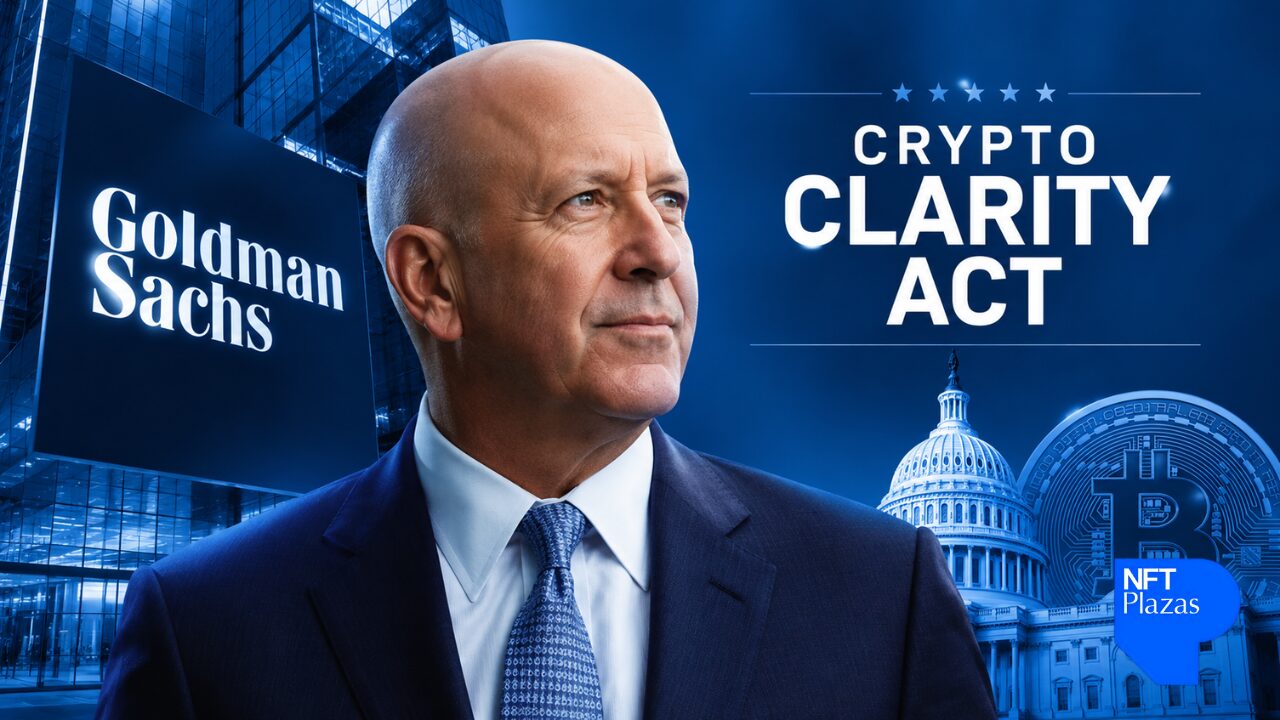
Goldman Sachs Chairman and CEO David Solomon has publicly endorsed the Digital Asset Market Clarity Act, breaking with much of the traditional banking industry as U.S. lawmakers move closer to a potential Senate vote on the landmark crypto legislation.
The endorsement positions one of Wall Street’s most influential banking leaders on the opposite side of a growing debate over how digital assets should be regulated. While several major banks have criticized key elements of the bill—particularly its treatment of stablecoin rewards—Solomon argued that regulatory clarity is essential for the industry’s long-term growth.
Speaking to Politico, Solomon said he is “very supportive of moving the CLARITY Act forward, so we can get some market structure in place and start to move the innovation process along.” He acknowledged that the legislation is “not perfect” but said its greatest strength is creating “a level playing field to enhance market stability and allow these markets to develop appropriately.”

Goldman Sachs CEO Breaks With Wall Street to Back Crypto Clarity Act
A Framework for Institutional Adoption
The CLARITY Act is one of the most significant crypto bills currently under consideration in Congress. If passed, it would establish a comprehensive regulatory framework for digital assets by defining the respective roles of the Securities and Exchange Commission (SEC) and the Commodity Futures Trading Commission (CFTC).
The legislation would classify most decentralized cryptocurrencies as commodities rather than securities, limiting the SEC’s oversight of much of the market. It also includes protections for decentralized software developers and addresses rules surrounding stablecoin reward programs—one of the bill’s most controversial provisions.
According to Politico, Solomon believes clearer regulations could encourage greater institutional participation in digital assets, an area where Goldman Sachs has steadily expanded its involvement in recent years.

The Process of The CLARITY Act
Stablecoin Rewards Divide Wall Street
The biggest source of disagreement remains stablecoin yield.
Stablecoins are digital tokens designed to maintain a fixed value, typically through a one-to-one peg with the U.S. dollar. They are widely used for crypto trading, cross-border payments, and decentralized finance applications.
Crypto firms such as Coinbase offer reward programs on certain stablecoin holdings, including Circle’s USDC, with annual returns often ranging between 3% and 5%—well above the interest rates available on many traditional savings accounts.
Supporters argue these rewards provide consumers with more competitive financial products, while critics say they resemble bank deposits without requiring crypto firms to meet the same regulatory standards.
Banking Industry Pushes Back
Solomon’s position stands in sharp contrast to JPMorgan Chase CEO Jamie Dimon, one of the legislation’s strongest critics.
Speaking to Fox Business earlier this year, Dimon argued that allowing crypto companies to offer yield on stablecoins without equivalent banking oversight would create an unfair competitive advantage.
“The banks will not accept it that way,” Dimon said, warning that such products could eventually create financial risks if they continue operating outside traditional banking regulations.
Banking trade groups have echoed those concerns, urging lawmakers to tighten the legislation. They argue that stablecoin rewards could encourage consumers to move deposits away from banks, weakening a key source of funding for traditional lending.
Crypto industry leaders disagree. Coinbase CEO Brian Armstrong has argued that banks are lobbying against stablecoin rewards because they threaten their deposit-based business model rather than because of legitimate consumer protection concerns.
Senate Vote Approaches
Solomon’s endorsement comes as Republican senators have released an updated version of the CLARITY Act ahead of a possible Senate floor vote.
The revised draft preserves the bill’s overall market structure while adding new ethics provisions governing digital asset activities by certain government officials. However, Democrats have argued that the changes do not go far enough, particularly regarding concerns surrounding President Donald Trump’s crypto-related business interests.
Lawmakers are still negotiating several outstanding issues, including stablecoin oversight, consumer protections, and rules governing yield-bearing products before the legislation can move forward.
Growing Divide Over Crypto Regulation
Goldman Sachs has gradually expanded its digital asset business through trading services, tokenization initiatives, and blockchain investments. Solomon’s comments represent one of the clearest public endorsements of comprehensive crypto legislation from the head of a major global bank.
His support also reflects a broader shift among some financial institutions that increasingly view regulatory certainty as the foundation for institutional adoption rather than a barrier to innovation.
Whether the CLARITY Act ultimately passes in its current form remains uncertain. However, Solomon’s backing highlights a growing divide within Wall Street itself. While some banks continue to view crypto legislation as a competitive threat, others see a clear regulatory framework as essential for bringing more institutional capital into digital asset markets and supporting the next phase of the industry’s growth.