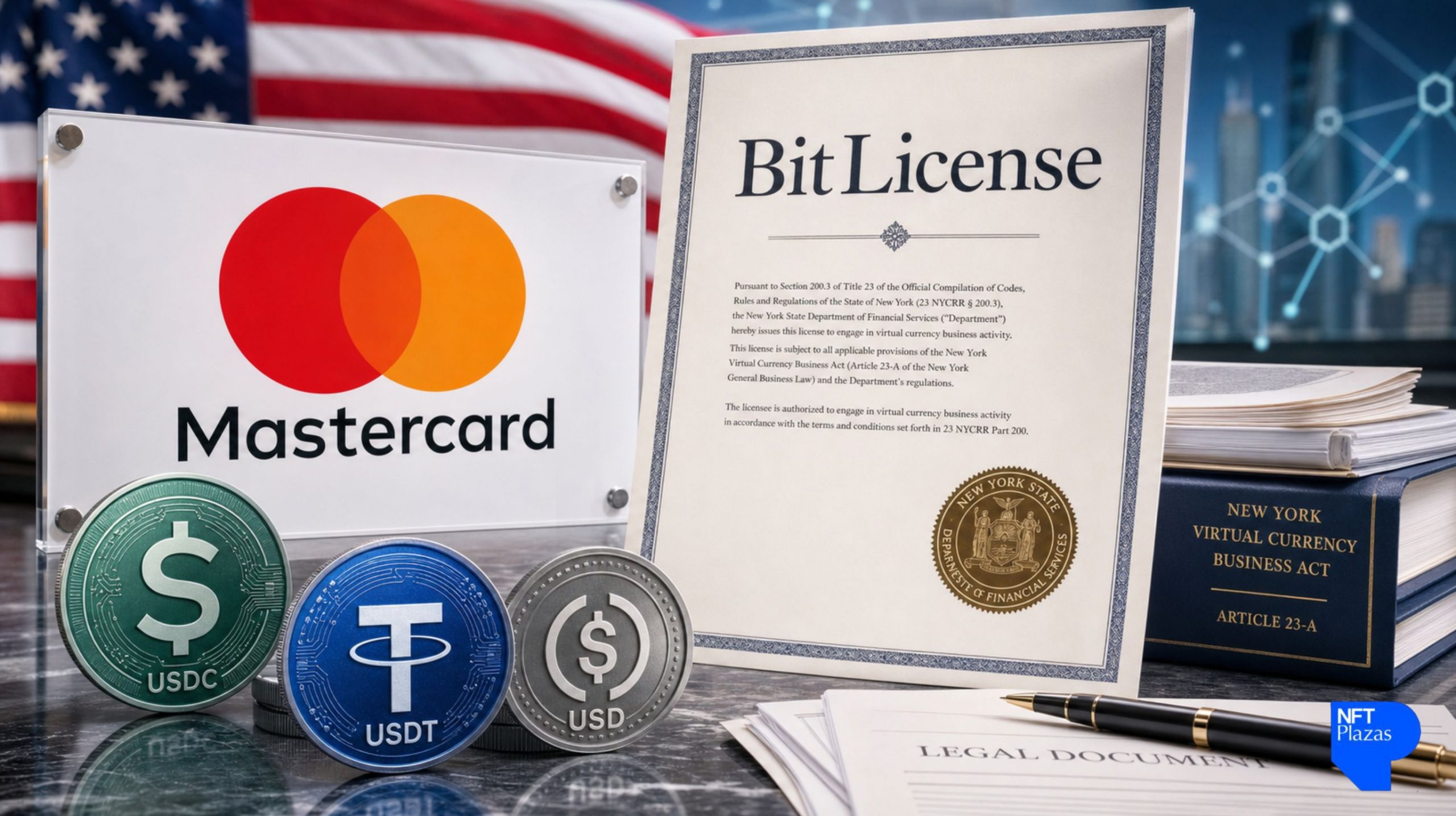
Mastercard Transaction Services (U.S.) LLC, a unit of Mastercard, has been granted a BitLicense by the New York Department of Financial Services (NYDFS) in May 2026, allowing the company to conduct digital asset-related activities in New York. This move reinforces Mastercard’s strategy in payment infrastructure and settlement for digital assets, including stablecoins and tokenized deposits, as traditional payment networks seek to connect the existing financial system with blockchain rails.
Mastercard Confirms BitLicense Approval
The BitLicense was granted to Mastercard Transaction Services (U.S.) LLC, a subsidiary of Mastercard, according to the NYDFS “regulated entities” list. The regulatory filing records the company with a “Virtual Currency License” type, issued in May 2026.
Mastercard also confirmed the approval in a post on X on May 27, calling it a step forward in its commitment to developing digital asset innovation in a safe and compliant manner.
Breaking news! Mastercard has been granted a BitLicense by the New York State Department of Financial Services (@NYDFS), advancing our commitment to secure and compliant digital asset innovation. 🗽🎉
Learn more: https://t.co/3aNHu3uwx6
— Mastercard (@Mastercard) May 27, 2026
For Mastercard, the new license establishes a clearer regulatory footing for digital asset activities in a key U.S. market. The company has not announced any new stablecoin products alongside this approval, but stated that the license aligns with its long-term strategy regarding digital currencies, stablecoins, and tokenized deposits.
Why the BitLicense Matters
The BitLicense is a permit issued by the NYDFS to businesses conducting “virtual currency business activity” involving New York or New York residents. It is one of the most closely watched digital asset licensing frameworks in the U.S., as licensed entities must meet stringent standards for consumer protection, cybersecurity, financial integrity, and operational capabilities.
According to the NYDFS, the BitLicense does not replace all other licenses. If a company handles both virtual currency and engages in fiat money transmission, it may still require a separate money transmission license under New York law. This is a notable point for major payment companies, as stablecoin payments often involve not just transferring tokens on-chain, but also conversion, payout, settlement, and reconciliation with traditional banking systems.
For a global payment network like Mastercard, such an approval helps mitigate regulatory risks when expanding digital asset use cases in New York, especially for products that require bridging blockchain rails with traditional payment systems.
The Stablecoin Infrastructure Push
Mastercard is not attempting to turn stablecoins into a payment method segregated from its existing network. The company stated it is developing end-to-end capabilities so that stablecoins can be integrated into the current payment ecosystem, spanning wallet enablement, card issuing, merchant settlement, to on-chain remittances.
At the product layer, Mastercard has partnered with crypto platforms such as MetaMask, Kraken, Gemini, Crypto.com, and Binance for card and wallet-related use cases. On the merchant side, the company is also working with Nuvei and Circle to enable merchants to receive settlement in stablecoins like USDC, while consumers can still pay using familiar methods.
At the infrastructure layer, the Mastercard Multi-Token Network supports real-time payment and redemption for digital assets. The planned acquisition of BVNK, announced in March 2026, further adds the capability to connect on-chain payments with fiat rails across more than 130 countries.
Mastercard’s current scale makes this strategy even more notable. In Q1 2026, the company reported net revenue of $8.4 billion and a gross dollar volume of $2.7 trillion. As of the end of March 2026, Mastercard’s customers had issued 3.7 billion Mastercard and Maestro cards. In 2025, Mastercard stated it processed over 175 billion transactions, demonstrating that stablecoin infrastructure, if deployed deeper, will sit on top of a global-scale payment network.
The Adoption Reality Check
Stablecoin payments are gaining more attention, but total on-chain volume does not directly reflect actual payment utilization. The majority of on-chain activity is not necessarily transactions between buyers, sellers, or businesses.
According to McKinsey and Artemis, real-world stablecoin payments are estimated at around $390 billion annualized. Within this, B2B payments account for approximately $226 billion, representing the largest segment within actual payments. This figure shows that stablecoin payments are gaining traction, but remain small compared to the scale of the global payment system.

Annualized stablecoin payment volume. Source: McKinsey & Artemis
Against this backdrop, the areas Mastercard emphasizes most are infrastructure, settlement, and the connection between stablecoins and existing payment rails. This is also where stablecoins hold a clearer advantage, ranging from cross-border payments, merchant settlement, to treasury operations and B2B transfers. The BitLicense gives Mastercard additional regulatory footing, but does not automatically turn stablecoin payments into a mass-market product.
What Comes Next for Mastercard
Following the BitLicense, the next focus is to what extent Mastercard will deploy digital asset activities in New York, through which products, and with which partners. The company has not announced any new stablecoin products alongside this approval, so the next steps will likely focus on infrastructure and settlement before expanding to consumer use cases.
Areas to watch include merchant settlement using stablecoins, stablecoin payouts via Mastercard Move, tokenized deposits on the Multi-Token Network, and the integration progress of BVNK if the deal closes. Another point is which specific stablecoins will be supported in New York, given that the NYDFS maintains its own greenlist, self-certification, and approval processes for virtual currencies.
With Mastercard’s global scale, the New York license adds regulatory foundation for products related to stablecoins and tokenized deposits. If subsequent products emerge, they will most likely target settlement and enterprise payments before becoming a familiar payment experience for consumers.
Disclaimer NFTPlazas provides trusted news and insights on Web3. The views expressed on this site do not constitute investment advice. Before making any high-risk investments in cryptocurrency or digital assets, please conduct your own thorough research. All transfers and transactions are carried out at your own risk, and any resulting losses are solely your responsibility. NFTPlazas does not endorse the buying or selling of cryptocurrencies or digital assets and is not a licensed investment advisor. Please also note that NFTPlazas may participate in affiliate marketing programs.